Ever googled yourself? If you haven’t, you probably should. What you’ll find might surprise you – and not in a good way.
These days, your personal information is scattered across the internet like breadcrumbs. Your old addresses, phone numbers, even details about your family members are sitting on websites you’ve never heard of, ready for anyone to find. It’s what I call the digital wild West – lawless, chaotic, and more than a little dangerous.
I’ve been dealing with cybersecurity issues for about fifteen years now, and I still remember the first time I really understood how deep this rabbit hole goes. I was investigating a data breach for a client when I decided to search for my own information. What I found made my stomach drop. There was my college apartment address from 1998, three different phone numbers, and somehow they even had my sister’s maiden name listed.
That was my wake-up call. Now I spend most of my time helping regular people figure out what’s out there about them and how to clean up the mess.
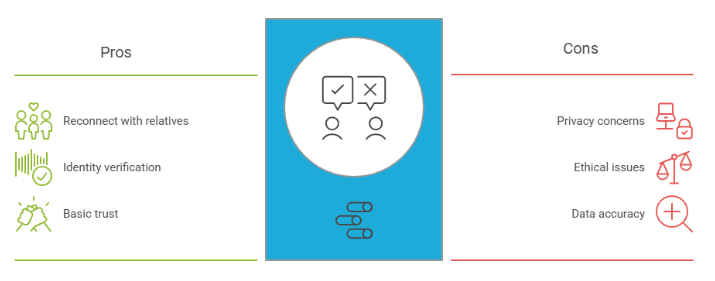
Let me break it down in simple terms so you can see exactly what you’re dealing with:
| PROS | CONS |
|---|---|
| Finding Lost Connections | Privacy Invasion |
| Reunite with family, old friends, classmates | Your personal info is searchable by anyone |
| Identity Verification | Stalking & Harassment |
| Basic background checks for dating, business | Makes it easy for bad actors to find you |
| Self-Monitoring | Data Inaccuracy |
| See what’s public about you | Wrong info can damage reputation |
| Genealogy Research | Identity Theft Risk |
| Build family trees, find relatives | Criminals use your data for scams |
| Professional Networking | Financial Vulnerability |
| Verify business contacts | Exposes financial records, bankruptcies |
| Safety Due Diligence | No Control Over Updates |
| Check out people before meetings | Your info stays online even after opt-outs |
Looking at this side-by-side, the cons definitely outweigh the pros for most people. The legitimate uses are helpful, but the risks are potentially life-changing.
What is Online People Search? Understanding the Basics
When most people think “people search,” they picture typing a name into Google. That’s kid stuff compared to what these specialized sites can do.
Beyond a Google Search: The Depth of Data
These aren’t your typical search engines. They’re more like digital private investigators that never sleep. While Google might show you someone’s LinkedIn profile or a news mention, people search engines dig way deeper.
Here’s how they work: Remember filling out that warranty card for your toaster? Signing up for that gym membership? Registering to vote? All that information gets sold, traded, and compiled. These companies buy data from hundreds of sources – public records, old phone books, magazine subscriptions, loyalty programs, social media, you name it.
The first time I mapped out all the data sources these companies use, it filled up an entire whiteboard. Property records, marriage certificates, business licenses, court filings, voter registrations – it’s endless. They take all these scattered pieces and connect them like a jigsaw puzzle until they have a pretty complete picture of your life.
Most people walk around completely unaware that this digital version of themselves even exists.
Common Uses of People Search Services
Look, I’m not here to bash these services entirely. People do use them for legitimate reasons, and sometimes they actually help.
Maybe you’re trying to track down your high school girlfriend for the reunion. Or you want to verify that the guy you met on Tinder actually lives where he says he does. Some landlords run quick checks on potential tenants, and genealogy researchers use them to fill in family trees.
The problem isn’t necessarily the tool itself – it’s how easy it makes things for people with bad intentions.
The “Pros” of Online People Search: When Is It Useful?
Despite my concerns about privacy, I’d be lying if I said these services never do any good. I’ve seen them help people in some genuinely meaningful ways.
Legitimate Connections and Reunions
One of my clients – I’ll call her Sarah – spent thirty years looking for her biological father. She’d hit dead ends with adoption agencies, hired two different private investigators, and spent thousands of dollars with no luck.
Finally, she tried a people search site. For forty bucks, she found an old address that led her to a neighbor who still had his current phone number. Within a week, they were talking for the first time since she was a baby.
Stories like Sarah’s remind me why these tools exist in the first place. When they help people reconnect with family or find long-lost friends, that’s genuinely beautiful.
Due Diligence and Verification
In today’s world, a little caution goes a long way. If you’re buying a car from some random person on Craigslist, or meeting up with someone from a dating app, running a quick background check isn’t paranoia – it’s smart.
I always tell people to think of it like checking references before you hire someone. You’re not being crazy; you’re being careful. Just don’t make it your only safety measure.
Protecting Yourself (Reversed Search)
Here’s something most people never think to do – search for yourself. I do this every couple months, and I recommend it to everyone.
About three years ago, I found an address from my college days still showing up, along with a phone number I hadn’t used since 2010. Seeing what was out there helped me understand what strangers could find about me and gave me a roadmap for cleaning things up.
Think of it as a check-up for your digital health.
The “Cons” of Online People Search: Navigating the Risks
Now we get to the part that keeps me up at night. The risks here are real, and they’re serious.
Privacy Breaches and Information Exposure
When I show people what these sites know about them, their jaws usually hit the floor. We’re talking current and former addresses, phone numbers, email addresses, names of family members, marriage and divorce records, property ownership, and even financial stuff like bankruptcies.
I worked with a woman last year who’d gone to extraordinary lengths to hide from her abusive ex-husband. New name, new city, new job – the works. But he found her anyway using a people search site. The database showed not just her new address, but her workplace and even which elementary school district her daughter was in.
That’s not just an invasion of privacy. That’s a legitimate safety threat.
The Risk of Misinformation and Outdated Data
Here’s what really gets me: these sites act like their information is gospel truth, but half the time it’s wrong.
I’ve seen people falsely linked to criminal records because they share a name with someone else. Old addresses that make it look like someone still lives somewhere they moved away from years ago. Phone numbers that belong to completely different people.
One of my clients got turned down for a mortgage because a people search site wrongly associated him with a bankruptcy filing from someone with a similar name in another state. It took six weeks and a lawyer to straighten out that mess.
Facilitating Harassment and Stalking
This is the part that makes me angry. Tools designed to help people reconnect are being used by stalkers and abusers to hunt down their victims.
I can’t tell you how many times I’ve had clients come to me because someone used these sites to find their home address or workplace. What starts as unwanted messages online quickly escalates to showing up at someone’s house or job.
The scary part is how easy it is. No special skills required – just a credit card and five minutes.
Phishing, Scams, and Identity Theft Vulnerabilities
Criminals love these sites because they provide all the ammunition needed for really convincing scams. When someone calls pretending to be from your bank and they already know your previous addresses, your mom’s maiden name, and where you went to college, you’re a lot more likely to believe them.
I’ve seen cases where thieves used information from people search sites to successfully impersonate victims when calling credit card companies. They knew enough personal details to get past the security questions and gain access to accounts.
My Expert Insights: Protecting Yourself in the Digital Age
After dealing with hundreds of privacy breaches and identity theft cases, I’ve figured out what actually works to protect yourself. The good news is you have more control than you think.
Opting Out: The First Line of Defense
Your first move should be requesting removal from the major people search sites. Fair warning – this is a pain in the ass. Each site has its own process, and there are dozens of them.
I spent an entire Memorial Day weekend going through this for myself a few years back. Some sites had simple online forms, others required mailing a written request with a copy of my driver’s license. The whole thing took about two months to complete, but it was worth every minute.
If you don’t want to tackle this nightmare yourself, companies like Optery and Incogni will do it for you. They charge around $100-200 a year, but they handle all the paperwork and keep monitoring for new sites.
Managing Your Social Media and Online Presence
Your Facebook and Instagram accounts are goldmines for these data collection companies. I’m constantly shocked by how much personal information people post publicly.
Birth dates, location check-ins, photos with house numbers visible in the background – it all gets scraped and added to these databases. Take an hour this weekend to lock down your privacy settings. Make sure you’re only sharing with actual friends, not the entire internet.
And please, stop posting vacation photos in real-time. Wait until you’re home.
The Power of Strong Passwords and Multi-Factor Authentication
Basic cybersecurity 101: use different passwords for everything, and turn on two-factor authentication wherever possible. I know it’s annoying, but password managers like Bitwarden make it painless.
This isn’t directly related to people search, but if your email or social media accounts get hacked, that gives criminals even more ammunition to use against you.
Regular Privacy Audits: My Recommended Practice
Set a reminder on your phone to google yourself every three months. See what comes up, and take action to address anything sketchy. Set up Google Alerts for your name so you’ll know when new stuff appears.
This isn’t just about people search sites – it’s about staying on top of your entire digital footprint. The sooner you catch problems, the easier they are to fix.
Ethical Considerations and the Future of People Search
The whole people search industry raises some pretty heavy questions about privacy and who really owns your personal information.
The Legal and Ethical Tightrope
Sure, a lot of this information is technically “public record.” But there’s a huge difference between someone having to physically go to a courthouse to look up property records and having everything available with a simple Google search.
Laws are starting to catch up. GDPR in Europe and CCPA in California give people more rights over their data, but enforcement is hit-or-miss. The technology is advancing faster than lawmakers can keep up.
What’s Next? My Predictions for Data Privacy
Artificial intelligence is going to make this whole situation both better and worse. AI will let companies connect even more dots about people, but it might also lead to better tools for protecting privacy.
I think we’re heading toward a future where people have more control over their verified information – deciding when and with whom to share it. We’re already seeing early versions of this with blockchain-based identity systems.
The Bottom Line: Pros vs Cons at a Glance
So is online people search safe? That’s the wrong question. The right question is: how do you make it safer for yourself?
These services exist, they’re legal, and they’re not going anywhere. The companies running them are making too much money to shut down voluntarily. So your choice is simple: stay informed and take action, or remain a sitting duck.
Empowering Your Digital Footprint
The most important thing I can tell you is this: you’re not helpless. It takes some effort to protect your privacy, but the steps I’ve outlined actually work.
Start small. Opt out of the biggest people search sites. Lock down your social media. Do a monthly search for your own name. Build from there as you get more comfortable.
Your privacy is worth fighting for. Don’t let anyone convince you otherwise.